
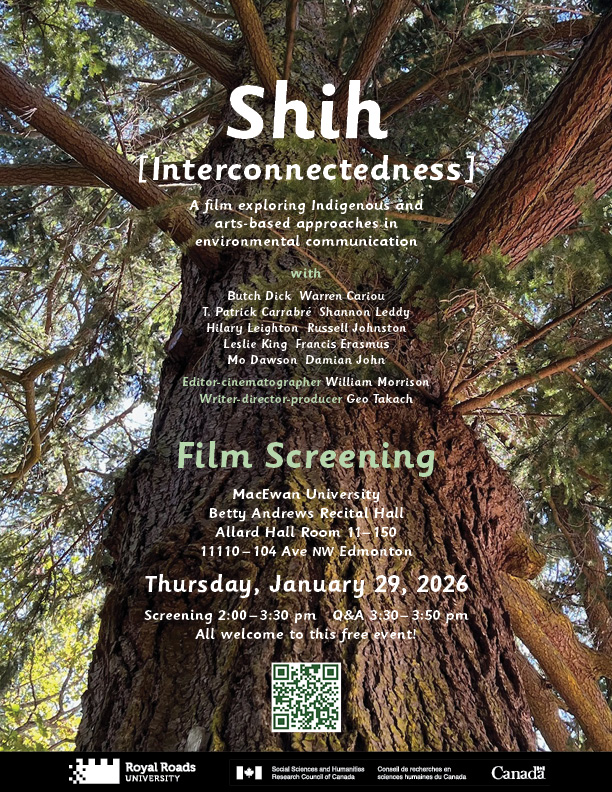
Our new feature film!
See the film trailer here .
31 December 2025
Our new feature-length film, Shih (Interconnectedness), is a multi-year collaboration engaging what I call my dream team, a remarkable cast of mostly Indigenous creators, teachers and collaborators. Together, we explore ways to interweave environmental, Indigenous and arts-based approaches as a foundation for improving relationships with the Earth and Her First Peoples.
The film is named on the inspiration and with the permission of the Tl’azt’en artist Damian John, whose work and ethos inspired me to invite him to discuss my inquiry. After some conversations, he graciously accepted a commission to paint his response to that question of how we might bring environmentalist thinking, Indigenous ways of knowing and being, and processes of artistic creation to the work of conciling (a term I prefer to the more popular reconciling) with the Earth and Her original human inhabitants. In the film, Damian notes that he has been discussing with his father, a Dakelh hereditary chief, the Dakelh word shih. Damian speaks to this as:
…this philosophy that’s embedded in our culture and means how connected and interconnected we are with the world around us, in a way where we have to have humbleness, we have to have an idea that life is much more than human life. And it’s in the mountains. It’s in the water. It’s in the air we breathe. It’s in our bones. The interconnectedness is everywhere.
Damian’s reflections on considering and creating the huge canvas that he ends up naming Shih accompany his eventual reveal of his finished work in the film.
There’s a lot more going on here. We take up that big question in two other ways. The first is in individual conversations.
These start with the Lekwungen master carver, educator and Elder Butch Dick, a much-respected and beloved figure on the south shore of what’s sometimes called Vancouver Island. Butch generously shares his experiences and wisdom, along with some history and childhood adventures on the shores of Esquimalt Lagoon (where much of our film takes place), and even a surprise song.
In seeking ideas on the confluence of arts-based, Indigenous and environmental approaches, I was delighted to find Shannon Leddy. Hailing from Treaty 6 territory and Métis Nation–Saskatchewan, Shannon is a prof at the University of British Columbia’s department of curriculum and pedagogy. Her quilt of interests spans art-education research, arts education, cultural studies, environmental education, Indigenous education research, media, semiotics, text studies, museum-education research, non-formal learning, pedagogy, philosophy, teacher-education research, and ways of knowing… to name just two. As a filmmaker, I’m always thrilled to see collaborators light up the screen, and Shannon certainly strikes me that way.
Striking what I’ll call a stirring chord in the film is the composer, conductor, professor and then-head of the music school at the University of British Columbia, T. Patrick Carrabré. Rooted in the Métis homeland in Red River, Pat has created and co-created a considerable oeuvre of live and recorded performances. The one that first caught my attention is his haunting album, 100,000 Lakes; background on that arts-based research is here, and the music itself is here. I find him a deeply insightful and passionate co-creator of this work, and I feel most fortunate to work with him.
Joining us from Treaty 1 territory and the Métis homeland through the miracle of 1s and 0s is one of my longtime heroes, the writer, filmmaker, visual artist and prof of English, theatre, film and media Warren Cariou. Among many contributions that have inspired me is his practice (dare one say invention?) of the art form he calls petrography, in which he brings actual bitumen from the banks of the Athabasca River to reviving pioneering techniques in photography to create images of the local landscape that I find both beautiful and terrifying. (Bitumen is the naturally occurring, tar-like substance that fuels what I call the economic bonanza and environmental catastrophe of the Athabasca tar/oil sands, to which I suggest adding the term bit-sands as a depolarizing tactic in a book called Tar Wars). While sitting with me at his professional home at the University of Manitoba, Warren noted that what I was doing here was in the realm of an Indigenous practice called research by visiting.
Another singular part of this merry mix for me is my dear colleague at Royal Roads University, the environmental prof, ecopsychologist and clinical therapist Hilary Leighton, who in locating her ancestry in various corners of the British Isles opines, “you can’t get more Celtic than that.” Hilary brings what I find to be an empathy for all life and a passion for teaching and learning that’s irrepressible and irresistible.
Beyond meeting each of these five giving souls in individual conversations, we join them all at a gathering for that purpose at Sneq’wa e’lun, the Blue Heron House, named by local Elders for the Indigenous centre of life on our campus at Royal Roads. Here they swap thoughts and ideas on how we can engage Indigenous, arts-based and environmental approaches to improve our relations with the Earth and Her First Peoples. Guiding this special visit is my friend and curriculum-creating and teaching confrere, Russell Johnston, Royal Roads’ Director of Indigenous Education. From his Anishinaabe roots, Russ shares and models teachings that continue to shape how I engage with the world, and he does so with what I’ll call his signature deep wisdom and grace.
Contributing to the gifts of these learned co-creators in the film are two special guests who join us virtually. The senior Indigenous-relations practitioner Francis Erasmus shares from his wealth of experience in managing relations among Indigenous and non-Indigenous peoples. He offers what I find to be particularly interesting observations on Indigenous art and an Indigenous sense of humour. Kindly referred to me by one of my graduate students in environmental communication, Francis happens to be a descendent of the legendary Métis farmer, teacher, interpreter and much more, Peter Erasmus (1833–1931).
Last but emphatically not least comes our second non-Indigenous onscreen luminary, environmental prof and director of the Canadian Centre for Environmental Education Leslie King. Leslie also toils at Royal Roads University, where she launched a certificate program in Indigenous environmental leadership. Adopted into the Nisga’a & Tsimshian (Kitselas) Nations, she brings her boundless energy and lifetime riches of experience in education and research with Indigenous peoples to suggesting ways forward in response to this inquiry.
In mulling over different ways to communicate my learning in this film, I hit on the idea of graphic recording, an art, science and vocation for which I have lofty regard. Imagine the skills required in standing at the back of a meeting hall, listening to what’s going on behind you, and then synthesizing, analyzing and representing it in the form of text and images in a mural—all in real time! So I discussed this project with Mo Dawson, an award-winning emerging entrepreneur of Kwakwaka’wakw and Gitxsan ancestry based in Lekwungen-speaking peoples’ territory. In addition to visually recording core elements of the film as discerned from our trailer with me live, he shares observations on his experience doing this particular gig and more broadly with his legacy of colonialism.
I add a hearty shout-out to my esteemed collaborator, William Morrison, perpetrator of the principal cinematography and the editing for the adventure in images, dialogue, sound and music that comes to you now as Shih (Interconnectedness). Further gratitude here to my AV buddies at Royal Roads, Brian Macdonald, Dan Anthon and Trevor Henry, for their steadfast support, and scores of other valued collaborators to be thanked later. It really does take a village to raise a film!
Initial screenings are underway. Please check back here for updates.
EDMONTON, AB: January 29, 2026, 2:30 pm, MacEwan University, Betty Andrews Recital Hall, 11110-104 Avenue NW. Free tickets available here.
CALGARY, AB: Southern Alberta Institute of Technology on February 6, 2026
VICTORIA, BC: Royal Roads University on February 25, 2026
VANCOUVER, BC: Details coming soon.
 Environmental Relations